Observation
Where each branch invested its effort
This experiment has the clearest surface-vs-substance split we've seen.
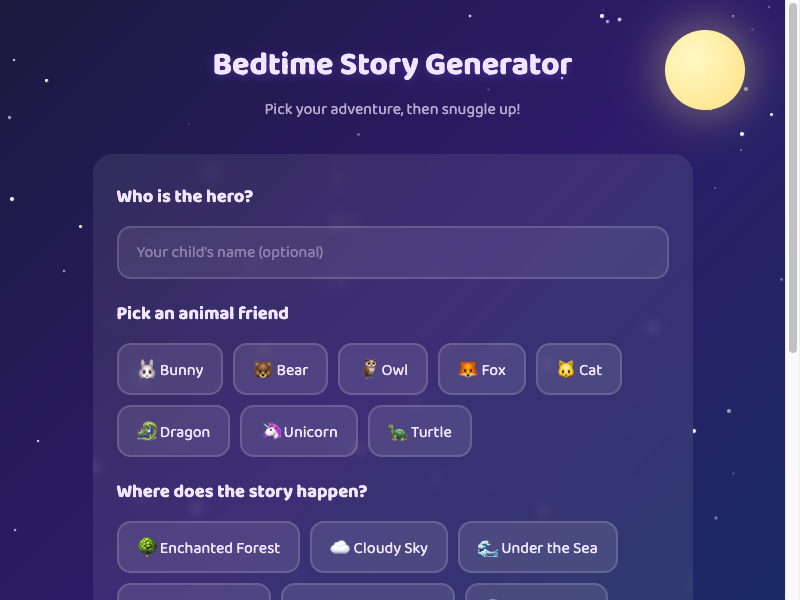
The prompt-only branch invested in the wrapper: twinkling CSS-animated stars, a moon graphic, a purple gradient background, a Google Fonts import, three customization dropdowns (animal, setting, theme). It looked beautiful. It had 5 story templates, selected randomly.
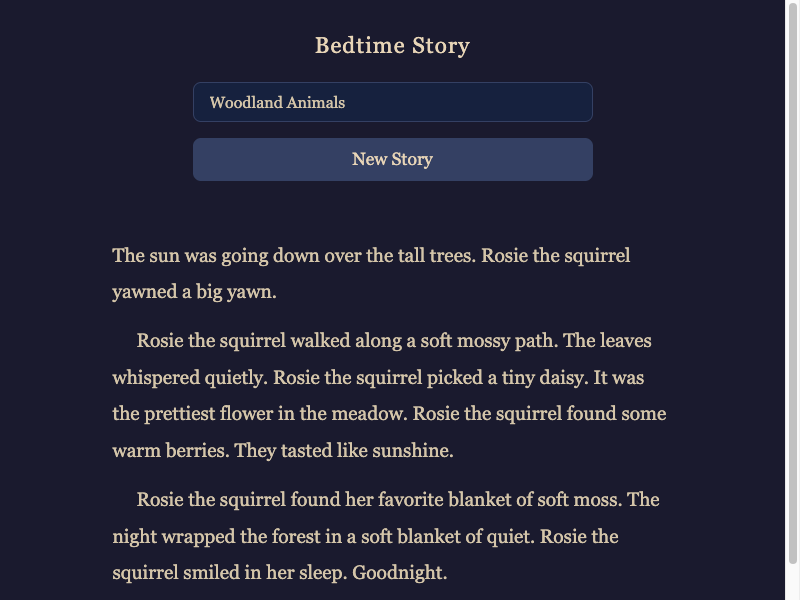
The intent-driven branch invested in the engine: 5 themes, each with deep template pools — 4 openings, combinations of 10 middle segments (choosing 3), 5 settling passages, 5 endings. That's over 12,000 unique story combinations per theme. A single theme dropdown and one "Tell Me a Story" button. Dark navy background with warm muted text. No animations. No external dependencies.
The child never sees the screen
This is the insight that separates the two branches. The prompt-only branch built an app that impresses the parent — the twinkling stars and the moon look great. The intent-driven branch built an app that serves the child — 12,000 story variations mean you could read a different story every night for 32 years.
The child hears the parent's voice reading words. The quality and variety of those words is the product. The stars and the moon are for nobody.
Content safety, two ways
Both branches treated content safety seriously — stories use gentle language and end in sleep. The structural difference: the prompt-only branch achieved safety by authorial convention (the templates happen to be safe). The intent-driven branch codified it as explicit constraints: no story fragment may introduce fear, danger, or anxiety, and every story must decelerate emotionally.
Convention works until someone adds a new template. Constraints work regardless.
Drift Analysis
Surface-over-substance drift (primary)
The prompt-only branch invested more energy in the visible wrapper (stars, moon, gradients, Google Fonts) than in the thing the product actually depends on (story variety and quality). This is surface-over-substance drift: themed visuals are strong, but the depth is shallow.
5 stories. After a week of bedtime reading, you've heard them all.
Constraint drift (secondary)
"For my 4-year-old daughter" is a constraint that implies: age-appropriate vocabulary, calming content, short enough to hold attention, no fear triggers. The prompt-only branch honored this at the content level (the stories are gentle) but drifted on scope — adding customization controls and visual complexity that a bedtime context doesn't need. The parent is reading in a dark room, not configuring dropdown menus.
Legitimate Divergence
- Theme selection UI: Three dropdowns (prompt-only) vs one dropdown (intent-driven). Different valid approaches to customization. The artifact didn't specify UI complexity.
- Color scheme: Purple gradient vs dark navy. Both appropriate for bedtime. Neither specified by the artifact beyond "bedroom-appropriate."
- Story structure: Random template selection vs combinatorial generation. Different valid approaches to variety. The artifact specified variety but not the mechanism.
Result
The hypothesis partially held. Both branches produced bedtime-appropriate content. But the intent-driven branch's investment in story depth (12,000+ vs 5 variations) and its restraint on UI features reflected a deeper understanding of what "bedtime story generator" means in practice.
The surface-vs-substance trade-off is the clearest finding: the prompt-only branch built a better-looking app. The intent-driven branch built a better story engine.
After one week of use, the prompt-only app would be repeating stories. After 32 years, the intent-driven app would still have new ones.
An app with twinkling stars but 5 stories will fail faster than an app with plain text and 12,000 stories.
Principle
When a prompt describes a tool that mediates a human ritual — bedtime reading, meditation, prayer — the screen is not the product. The ritual is. Intent discovery can redirect implementation effort from the visible interface to the content or interaction that the ritual actually depends on.
Ask: who is the real audience? If the answer is "someone who never sees the screen," every pixel of visual polish is effort spent on the wrong thing.
Follow-Up
- Test both versions with a parent over several weeks. Which produces more satisfying nightly use?
- Does the name input (present in prompt-only, absent in intent-driven) make a meaningful difference to the child's engagement?
- Would the intent-driven branch's explicit content safety constraints be useful as a review framework for adding new templates?
- Test with a prompt where screen quality matters more ("a visual meditation timer") to see if the surface-vs-substance pattern reverses
Limitations
- Both branches used the same model family. The tendency toward visual polish might be model-specific.
- "Better story engine" is our assessment based on combinatorial variety. A parent might prefer 5 curated stories over 12,000 generated ones — quality vs quantity is a real trade-off we didn't test.
- Single run per branch. The prompt-only agent might invest in story depth on another run.
- The intent-driven branch received more structured input. The "ritual mediator" framing was in the artifact, shaping the implementation toward content depth.
- We assumed the child never sees the screen. Some parents might show the screen to the child as part of the ritual — in which case the twinkling stars are relevant.
- Neither branch used AI generation. Both relied on templates. A real bedtime story generator might use an LLM, which would change the variety calculation entirely.