Observation
The features converged
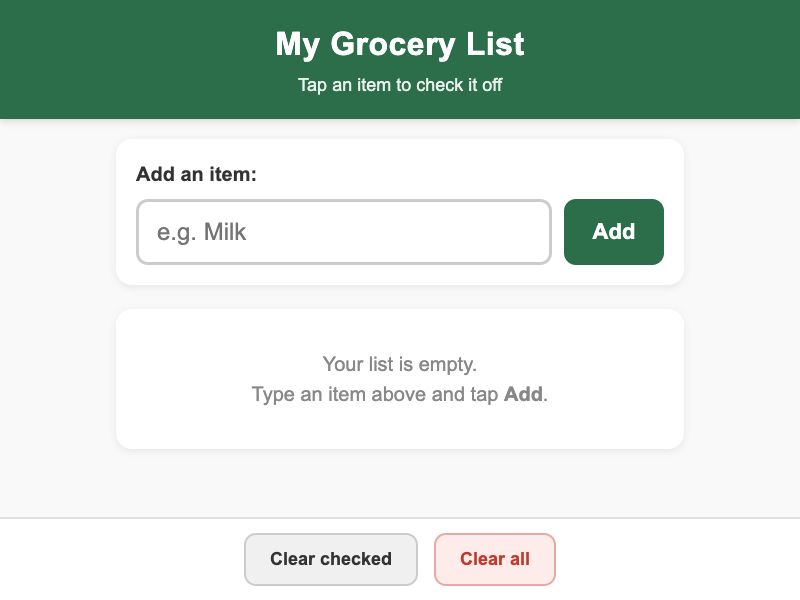
Both branches built essentially the same app. Large text (20px+). Large touch targets (44-48px+). High contrast. Confirmation dialogs on destructive actions. localStorage persistence. Aggressive feature exclusion — neither added categories, prices, sharing, or recipe integration.
Both independently identified the absence of a sharing feature as the most significant gap.
This was the first experiment where we saw this level of convergence. The features matched almost exactly.
The reasoning diverged
The prompt-only branch described what it built as "an accessibility-first tool."
The intent-driven branch described what it built as "a small act of care expressed as software."
Same app. Different understanding of why it exists.
The intent-driven branch's protected value PV2 — "Forgiveness over efficiency" — reframed confirmation dialogs from a standard accessibility pattern into something more specific: this user might feel anxious about pressing the wrong button. The dialog isn't about preventing data loss. It's about making the app feel safe to use.
What "elderly mother" does to a prompt
"Elderly mother" is a remarkably strong persona constraint. It naturally resists scope inflation because the answer to "should I add this feature?" is almost always "no, that would confuse her." Both agents independently arrived at that conclusion.
Drift Analysis
This experiment showed less feature-level drift than any other in our batch. Both branches arrived at similar designs because "elderly mother" is strong enough to constrain the design space on its own.
The drift that occurred was in framing, not features. The prompt-only branch built from the question: "What should a grocery list app look like for someone elderly?" The intent-driven branch built from: "What does it mean to build software as an act of care?"
The features converged. The decision rationale diverged.
Legitimate Divergence
Nearly everything here is legitimate divergence — both branches made valid choices that arrived at the same place:
- Touch target sizing: 44px vs 48px. Both adequate for the persona. The artifact didn't specify exact pixel values.
- Visual design: Different color schemes, both high-contrast. The artifact specified accessibility, not aesthetics.
- Persistence approach: Both chose localStorage independently. The artifact specified local persistence but not mechanism.
The convergence itself is the finding. When both constrained and unconstrained agents build the same thing, the prompt is doing the work that intent discovery usually does.
Result
The hypothesis partially held. The prompt-only branch did treat "elderly mother" primarily as an accessibility modifier — but it did so competently. The implementation was well-adapted to the persona. The intent-driven branch surfaced the relational dimension ("care") but this didn't produce dramatically different features.
This is an honest result, and it's important: not every experiment shows dramatic drift. Strong persona constraints in prompts can naturally resist drift in both approaches. Intent discovery's value here was less about preventing the wrong product and more about articulating why the right product is right — turning implicit assumptions into explicit values.
The "Forgiveness over efficiency" framing might not change this app. But it would change decisions in a more complex app with more design surface.
Principle
When a prompt contains a strong user persona, both approaches may converge on similar features because the persona naturally constrains the design space. Intent discovery's value in these cases is less about preventing drift and more about making the reasoning explicit — articulating values that can guide future decisions beyond this single implementation.
Convergence is a finding, not a non-result.
Follow-Up
- Test with a weaker persona ("for my friend" or "for students") to see if convergence holds
- Test whether the "care" framing leads to different decisions in a more complex app with more design surface
- Would the products diverge if the prompt said "for my elderly mother who lives in another city"? Sharing might become a protected value instead of a noted gap.
Limitations
- Both branches used the same model family. The convergence might partly reflect model-specific training patterns around accessibility.
- Single run per branch. The prompt-only agent might frame differently on another run.
- "Elderly mother" is an unusually strong persona constraint. This convergence pattern may not generalize to weaker persona prompts.
- The intent-driven branch received more structured input, but since features converged anyway, the context volume confound is less relevant here.
- The "care" framing is an interpretive difference we observed in the summaries. We can't measure whether it would produce different outcomes in a more complex project.